Pain
Behind the comic
What is your research about - in one sentence?
We study the psychological and neural mechanisms that shape how much pain we feel.
What does the comic show?
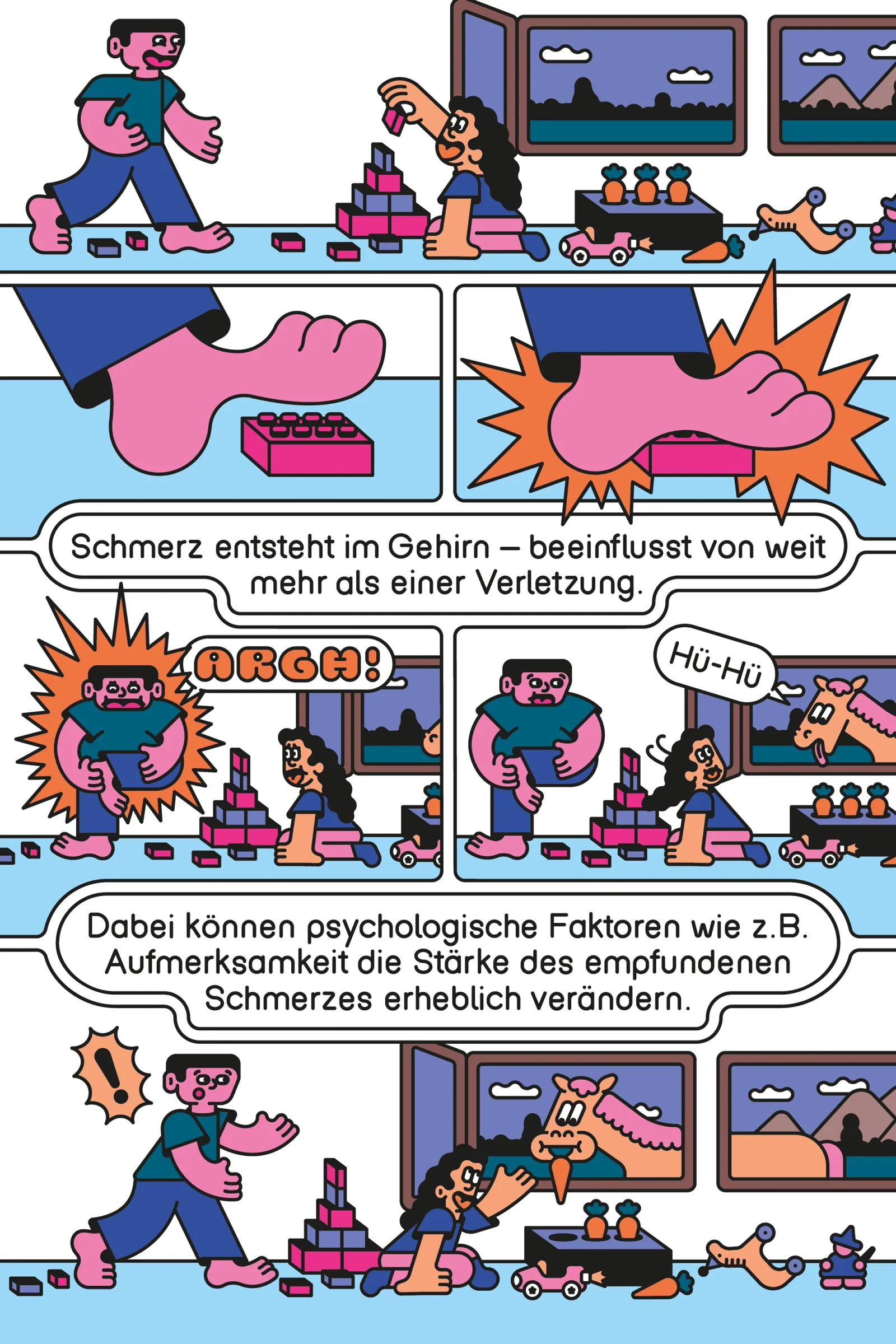
Our comic shows how a sudden distraction – the unexpected appearance of a horse outside the window – can strongly weaken the pain we feel, because we are attending to something else. This is meant as an example of how pain isn't something hard-wired that always happens after an injury, but can instead be flexibly modulated. There are many situations where this happens – not only with attention to or away from pain, but also with the expectations we hold or the emotions we feel. In such situations, the experienced pain can be weakened or strengthened, depending on the context. We study how it is possible that the same painful input can lead to such different experiences, and which processes in the nervous system underlie this remarkable ability to flexibly change our perception.
What findings support this idea?
There is a lot of evidence for this kind of flexible pain modulation. For example, several studies have shown that focusing attention elsewhere reduces pain, and that this effect is mediated by the body's own opioid system.
A related phenomenon is the placebo effect: when people believe they are receiving a pain-relieving substance, they report less pain — even when that substance is completely inert. Interestingly, placebo pain relief relies on similar opioid-related mechanisms in the brain.
Importantly, these pain-modulating pathways were first discovered decades ago in animal studies, showing that this capacity for modulation is not unique to humans but shared across many species.
What are the limits and common misunderstandings?
One should always be careful about generalizing and extrapolating research findings. For example, this research does not claim that we can simply create pain out of nothing, or easily abolish pain completely through the power of cognitive processes. Similarly, we need to acknowledge that the capacity to control or modulate pain varies strongly across individuals, and the phenomena described above do not apply to everybody to the same degree. Furthermore, an important limitation of some studies is that participants might guess the aim of the experiment and behave accordingly – this is by no means specific to pain research, but it can be a confound.
What questions are still unanswered?
There are many questions that remain largely unanswered. On the neurobiological level, for example, we still don't have a detailed understanding of the different pathways that underlie the modulation of pain in humans. Similarly, it remains unclear which pharmacological pathways are involved in pain modulation – for example, what role endogenous cannabinoids play.
With respect to observable behaviour, it is still unclear why some people have a larger capacity for pain modulation than others, for example by showing larger placebo effects. One might also ask whether it would be possible to boost someone's psychological and neural capacity to modulate pain. Finally, what are the limits of human pain control, and how do these limits change depending on situational circumstances?
How could this shape future medicine?
We believe that therapeutic approaches to pain – especially pain in its clinical and chronic form – should harness this endogenous modulatory power. This starts, for example, with a positive patient-provider interaction that builds trust and shapes the patient's expectations toward treatment success. Optimizing such expectation effects could also help reduce the use of analgesic drugs, including opioids, which carry a certain risk of side effects and addiction. Finally, understanding the pain-modulatory processes at work in the healthy state might give hints as to what goes wrong with these processes in the diseased state, and could reveal targets for future clinical interventions.
What societal and ethical questions does this raise?
Chronic pain affects about one in five adults, and this number is likely to increase as the population ages, since chronic pain becomes more common with advancing age. Understanding the neurobiological and neuropharmacological mechanisms underlying pain could therefore inform new treatment approaches. This is clearly relevant from the perspective of reducing suffering, but also from a socioeconomic perspective, given the burden chronic pain places on healthcare systems and societal productivity.
Day-to-day ethical challenges in this kind of research include administering painful stimuli to healthy participants, and ensuring that pain is induced in a controlled way that never causes actual harm. From a clinical standpoint, the fact that pain is highly subjective and can be shaped by attention, expectation, and emotion also implies that physicians should not dismiss a patient's pain simply because its intensity seems disproportionate to a visible injury or diagnosis.
How do you study this topic?
In our experiments, we mostly induce pain with devices that deliver painfully cold or hot stimuli to the skin of participants. We then typically record several measures at the same time, so that we can link participants' experience with ongoing processes in their nervous system. On the one hand, we are interested in our participants' behavioral responses: for example, on each trial of an experiment they might have to answer questions such as "How painful was this stimulus?" or "What is your expectation regarding the upcoming painful stimulation?" At the same time, we often record nervous system responses in three different ways, depending on the type of experiment. First, we record pain-related responses from the autonomic nervous system, such as how strongly the pupil dilates or how much a person sweats. Second, we record the electrical signals of neurons in the brain and spinal cord, for example via electroencephalography (EEG). And third, we try to spatially localize responses in the brain and spinal cord using functional magnetic resonance imaging (fMRI).
Where it's set
About the Project
science streets is a science communication project that brings science into everyday life by transforming Leipzig’s public spaces into places of learning. For four weeks in August 2026, science comics will be displayed on advertising spaces, such as advertising pillars, city-light posters, information screens, and public transport. With this year’s theme being neuroscience, we are part of the Science Year 2026 – Medicine of the future. Eleven scientists and eleven illustrators will be selected to collaborate on comics about the brain: the scientists provide the content, while the illustrators bring it to life artistically. At the "Art & Science Open Air", which hosts our closing event funded by the Daimler und Benz Stiftung, you can dive even deeper into the topics.
Videos