Brain Age
Behind the comic
What is your research about - in one sentence?
We search for manifestations of biological aging processes in the human brain using explainable artificial intelligence (XAI) and relate them to general health and lifestyle choices.
What does the comic show?
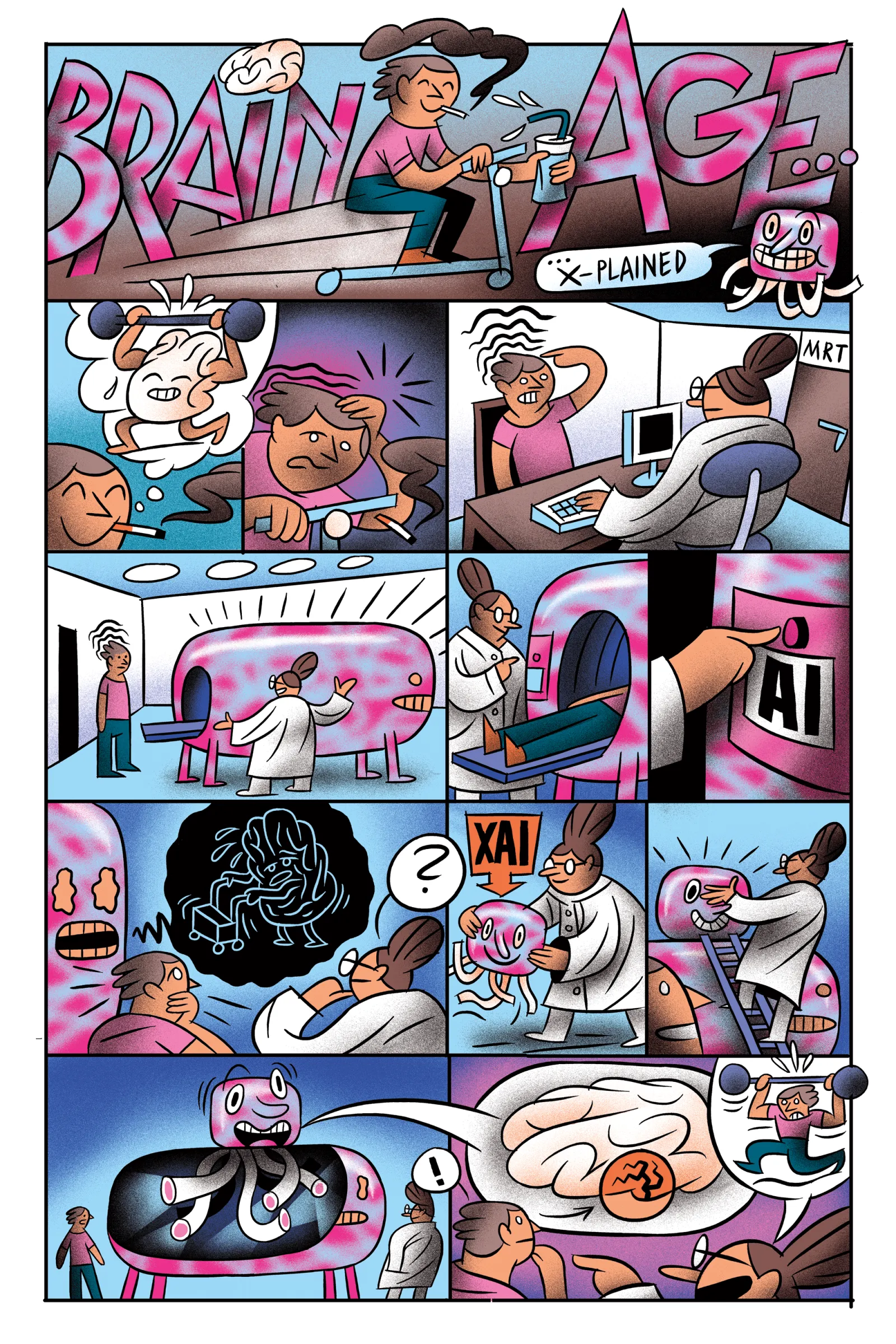
The comic shows us how we can use artificial intelligence (AI), more specifically, deep neural networks, to help with the diagnosis of biological conditions of patients when provided with medical imaging data (here MR images). The comic also illustrates how we can use algorithmic techniques, called explainable AI (XAI), to make the AI-model predictions more transparent and understandable to both doctors and patients. In the comic, a young person has to learn that their brain is not as fit or as ‘young’ anymore as they think, and that some of their lifestyle choices might be responsible for their heightened brain age. Beyond what the comic wonderfully illustrates, XAI is not only relevant for medical applications, but also plays a crucial role in scientific discoveries. We use these techniques not only for MR images of the brain, but also to analyze EEG data, and study human behavior and perception.
What findings support this idea?
The XAI method we use in our research produces so-called heatmaps. These maps highlight parts of the MRI (a 3D brain image) that the AI model used to estimate a person's brain age. We trained our initial brain-age model on data from more than 2000 study participants, who were between 18 and 82 years of age, and all from the Leipzig area. We then thoroughly tested the model’s accuracy on image data, which the model had not seen during its training, and we could show that its prediction error is very small. After applying our XAI algorithm, we compared the resulting heatmaps with previous findings on aging processes in the brain and found that the AI model relies on many biological, meaningful manifestations of aging. For example, when we get older, more and more of so-called white-matter hyperintensities appear in our brains. These are tiny lesions usually in deeper structures of the brain. Without being explicitly trained on such lesions, our AI model detected them and considered them relevant for its brain-age predictions. We found similar patterns for many other aging-related features in the brain.
What are the limits and common misunderstandings?
A person’s brain-age score is not as fixed as their chronological age. For example, studies show that a lack of sleep can temporarily increase your brain age. But after a good night of sleep, the score can improve, that is, lower again. Thus, drawing conclusions based on an individual brain scan should be taken with caution.
More generally, artificial intelligence is often considered a magic wand that might solve all our (scientific) challenges. But these models bring their own difficulties. They might base their decisions on the wrong aspects of the data that are given to them. At the same time, AI models are very complex, which makes them difficult to interpret. While we use explainable AI (XAI) techniques to tackle this complexity, the term „explainable“ in XAI can be read as too promising. The heatmaps we generate with these methods do not „explain“ something to us per se, but are still subject to further analysis. In other words, to make sense of these XAI-based heatmaps, the researcher or practitioner needs domain-knowledge, in our case, knowledge about the brain. Some years ago, the Nobel-prize laureate Geoffrey Hinton predicted that we soon do not need radiologists anymore because of developments in AI. Today, the opposite holds true; in fact, radiologists are scarce in many countries. XAI-based science and medicine will play more and more a central role; however, it won’t be a technology to replace humans but to assist them.
What questions are still unanswered?
In the research field of XAI, more work has to be done to make the inner workings of AI models, that is, deep artificial neural networks, even more transparent. As mentioned above, heatmaps do not explain themselves but require further investigation. With new techniques, we want to integrate domain knowledge directly into the „explanations“. More specifically, findings from previous experiments should automatically enrich these explanations. At the same time, uncertainties in terms of model predictions as well as in terms of their explanation need to be outlined more carefully; ultimately, these uncertainties can be very insightful for researchers. For example, if a future XAI technique is not able to relate certain aspects of the highlighted brain area to previous knowledge, we want the XAI method to indicate this to us – „wisdom is knowing what you don’t know“. In turn, this would point researchers towards exciting new endeavors for scientific research.
How could this shape future medicine?
AI models are starting to play a more and more important role in medicine. While their wide adoption still requires further quality assessments and guardrails, their potential advantage is large. In this development, XAI will play a central role for a safe development and application of these models, for providing insights to practitioners, and for the communication to patients. Brain age is just one example of what these models can learn to predict. While brain age is more of a global health marker, we have many AI-based expert systems already today specialized in diagnosing specific diseases that can run in parallel on brain scans and other medical probes. For practitioners and medical researchers, these systems can be extended with knowledge bases where model outputs can be enriched by and linked to the most recent scientific findings.
What societal and ethical questions does this raise?
This research creates possibilities for earlier and more personalized (brain‑)health care, but it also raises important questions about how society deals with the sensitive topic of AI-based diagnostics.
Explainable AI (XAI) can make these complex models more transparent for doctors and patients, potentially strengthening trust, improving shared decision‑making, and helping people better understand how sleep, exercise, and other habits are linked to their brain health.
On an ethical note, there is a risk of bias and unfair treatment: if models are trained mainly on certain groups (e.g., our model was trained on the data of Leipzig’s citizens only), they may be less accurate for others, which could reinforce existing health inequalities or lead to misleading risk assessments.
Another question concerns the psychological impact: learning that one’s brain appears “older” than one’s actual age might motivate positive lifestyle changes, but it could also cause distress, stigma, or fatalistic thinking if results are presented without proper explanation and context.
Finally, as AI systems become more deeply embedded in healthcare, society has to decide how much responsibility we delegate to algorithms versus human experts, how we regulate these tools, and how we ensure that XAI is used to support human judgment and patient dialogue rather than to replace it.
How do you study this topic?
In our research, we use so-called deep neural networks – a type of computational model from the broader field of machine learning. These artificial networks were originally inspired by the way neurons in the brain fire and transmit signals. Of course, there are far more differences than similarities between artificial systems running on computers and the biological brain. Nevertheless, the scientific community has apparently succeeded in identifying useful principles inspired by the brain that can be translated into impressive computational applications.
Today, deep neural networks are at the core of many applications that use what is commonly referred to as “AI”. In our study, we trained these artificial neural networks using MRI data to predict a person’s age.
In a second step, we applied an algorithm called Layer-wise Relevance Propagation (LRP). LRP belongs to the family of explainable artificial intelligence (XAI) methods and allows us to analyse the predictions made by deep neural networks. When our AI models estimate a person’s brain age based on their MRI scan, the LRP algorithm produces a heatmap. This heatmap highlights the regions of the brain that contributed most strongly to the model’s prediction. For this reason, such heatmaps are often referred to as relevance maps.
Where can I learn more about this topic?
For“non-readers,” there is a podcast interview with me on AI in medicine and neuroscience (which covers also the topic of brain age): https://detektor.fm/wissen/ach-mensch-simon-hofmann
The data for our study comes from: LIFE – Leipziger Forschungszentrum für Zivilisationserkrankungen: https://www.uniklinikum-leipzig.de/einrichtungen/life
A video recording of a presentation on explainable AI (XAI) methods, including the LRP algorithm, by a collaborator: https://www.cbs.mpg.de/cbs-coconut/lapuschkin
References
Hofmann, S. M., Beyer, F., Lapuschkin, S., Goltermann, O., Loeffler, M., Müller, K.-R., Villringer, A., Samek, W., & Witte, A. V. (2022). Towards the Interpretability of Deep Learning Models for Multi-modal Neuroimaging: Finding Structural Changes of the Ageing Brain. NeuroImage, 261, 119504. https://doi.org/10.1016/j.neuroimage.2022.119504
Hofmann, S. M., Goltermann, O., Scherf, N., Müller, K.-R., Löffler, M., Villringer, A., Gaebler, M., Witte, A. V., & Beyer, F. (2025). The utility of explainable AI for MRI analysis: Relating model predictions to neuroimaging features of the aging brain. Imaging Neuroscience, 3, imag_a_00497. https://doi.org/10.1162/imag_a_00497
Where it's set
About the Project
science streets is a science communication project that brings science into everyday life by transforming Leipzig’s public spaces into places of learning. For four weeks in August 2026, science comics will be displayed on advertising spaces, such as advertising pillars, city-light posters, information screens, and public transport. With this year’s theme being neuroscience, we are part of the Science Year 2026 – Medicine of the future. Eleven scientists and eleven illustrators will be selected to collaborate on comics about the brain: the scientists provide the content, while the illustrators bring it to life artistically. At the "Art & Science Open Air", which hosts our closing event funded by the Daimler und Benz Stiftung, you can dive even deeper into the topics.
Videos
 Featured
 Featured