Ageing Brain
Behind the comic
What is your research about - in one sentence?
We study how aging shapes the way our brain stores and retrieves the information and concepts we have learned throughout life, for example when we want to say a word.
What does the comic show?
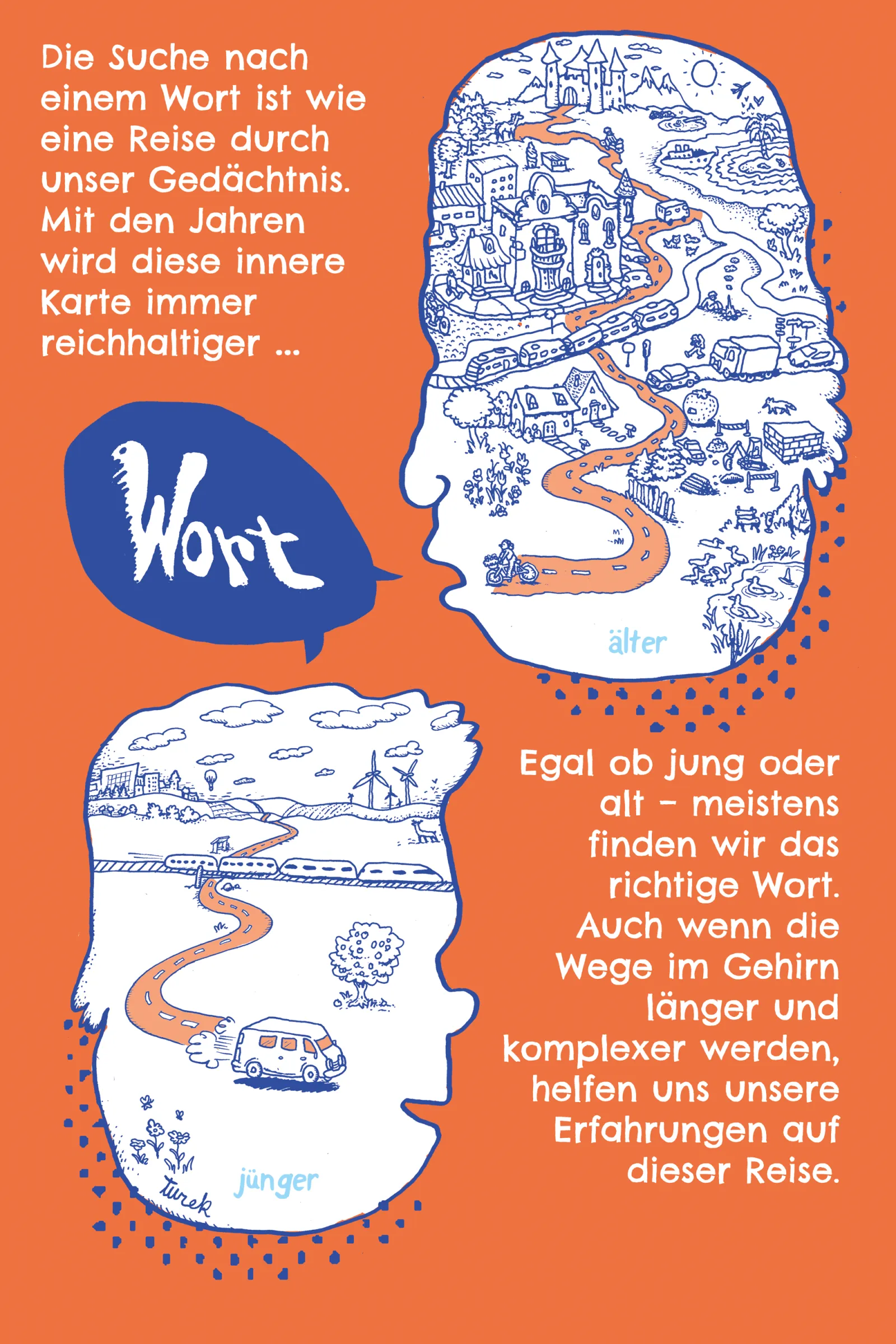
The comic shows how aging changes the routes our brain takes to find a word. It contrasts a younger and an older person's mind: although both find the right word in the end, the paths to these words are quite different. In older people, these routes are shaped by a lifetime of experiences, and that richness can make up for routes that seem longer or less direct.
What findings support this idea?
Modern brain imaging tools let researchers follow neural activity in real time, revealing networks of regions that fire together for a given task. A key finding of recent decades is that these networks change substantially as we age, especially in how different brain regions communicate with each other.
In one of our own studies, participants named items from different categories inside a brain scanner (for example: animals and fruits as easier, insects and metals as more complicated to name). Even when younger and older participants performed equally well, older brains showed stronger involvement of cognitive control networks alongside the concept network. Other research groups have found that the network encoding personal concepts and experiences also becomes more engaged in older adults, helping to sustain performance.
Together, these findings suggest that the brain compensates for changes in processing efficiency by recruiting richer, more distributed networks — much like taking a scenic route that draws on more of the map.
What are the limits and common misunderstandings?
Our research does not give an answer to the question of how we might stop getting older, or how we can cure diseases like Alzheimer's or other forms of dementia. Instead, our findings lay a foundation by helping us understand what exactly happens in the brain as we get older, and why word-finding difficulties and tip-of-the-tongue phenomena become more common with aging. This basis can in turn be used for developing better tools to distinguish healthy aging from early signs of disease, and for designing interventions that support the aging brain.
What questions are still unanswered?
As you are probably aware, aging is a highly individual process, and this is true for the aging brain as well. While we know that brain networks reorganize over the lifespan, we do not yet fully understand what drives these changes or why they vary so much from person to person. It also remains unclear where exactly the boundary lies between healthy aging and the early stages of neurodegenerative disease, and whether the compensatory strategies the brain develops can be actively trained or strengthened. Finally, many researchers are asking how factors such as multilingualism, education, or lifestyle shape the aging brain's inner map of words and concepts, and which of them might help support healthy brain aging in the future.
How could this shape future medicine?
This research could contribute to the medicine of the future by showing that the aging brain is not only vulnerable, but also adaptable. If we understand more precisely how the brain reorganizes and compensates for age-related changes, we may be able to develop better tools to distinguish healthy aging from early disease, identify who is at greater risk of decline, and design interventions that strengthen supportive brain mechanisms before serious problems arise. In this way, research on the plasticity of the aging brain could help make future medicine more preventive, personalized, and focused on maintaining cognitive health for longer.
What societal and ethical questions does this raise?
One important message of our research is that healthy cognitive aging is not simply a story of loss. While some abilities, such as processing speed or short-term memory, may become less efficient with age, knowledge about words, concepts, and the world often remains robust and continue to grow across the lifespan. Older adults can draw on this rich store of knowledge and experience to support communication and everyday thinking, even when some specific processes become slower. This creates opportunities for society. It can help us challenge stereotypes about aging, support more inclusive education and healthcare, and design technologies that build on the strengths of older adults instead of focusing only on deficits. Our work encourages a more positive, nuanced view of aging.
How do you study this topic?
To study the networks in the brain, we use neuroimaging tools, most often electroencephalography (EEG) and magnetic resonance imaging (MRI, or brain scanning). Usually, we have people perform a task in the MRI scanner, which helps us directly see which networks are involved. We also often collect data while the brain is at rest, which helps us investigate the effects of aging on the brain in the absence of a task, and we measure the white matter long-range pathways that connect local grey matter cortical regions. These white matter pathways give us additional information about how strongly some regions are connected to each other. Ideally, we can then relate the measures from the MRI to performance measures such as response speed, accuracy, and other cognitive scores for memory and language to see whether there is a direct relationship. For instance, we might observe that people with better working memory abilities are faster at finding words from specific semantic categories.
Where can I learn more about this topic?
Open access article on age-related changes to the functional network architecture: https://doi.org/10.1093/cercor/bhac387
Open access chapter on language and aging from the Oxford Handbook of Neurolinguistics: https://osf.io/preprints/psyarxiv/xp29u_v1
Open access article on age-related changes to the role of domain-general networks of cognitive control in semantic processing: https://doi.org/10.1093/cercor/bhab252
Article on the benefit of multilingualism in aging:
References
Cabeza, R., Albert, M., Belleville, S., Craik, F. I. M., Duarte, A., Grady, C. L., Lindenberger, U., Nyberg, L., Park, D. C., Reuter-Lorenz, P. A., Rugg, M. D., Steffener, J., & Rajah, M. N. (2018). Maintenance, reserve and compensation: The cognitive neuroscience of healthy ageing. Nature Reviews Neuroscience, 19(11), 701–710. https://doi.org/10.1038/s41583-018-0068-2
Hoffman, P., & Morcom, A. M. (2018). Age-related changes in the neural networks supporting semantic cognition: A meta-analysis of 47 functional neuroimaging studies. Neuroscience & Biobehavioral Reviews, 84, 134–150. https://doi.org/10.1016/j.neubiorev.2017.11.010
Park, D. C., & Reuter-Lorenz, P. (2009). The Adaptive Brain: Aging and Neurocognitive Scaffolding. Annual Review of Psychology, 60, 173. https://doi.org/10.1146/annurev.psych.59.103006.093656
Where it's set
About the Project
science streets is a science communication project that brings science into everyday life by transforming Leipzig’s public spaces into places of learning. For four weeks in August 2026, science comics will be displayed on advertising spaces, such as advertising pillars, city-light posters, information screens, and public transport. With this year’s theme being neuroscience, we are part of the Science Year 2026 – Medicine of the future. Eleven scientists and eleven illustrators will be selected to collaborate on comics about the brain: the scientists provide the content, while the illustrators bring it to life artistically. At the "Art & Science Open Air", which hosts our closing event funded by the Daimler und Benz Stiftung, you can dive even deeper into the topics.
Videos
 Featured
 Featured
 Featured